Jun 14, 2026 / 6 min read
Building grep in Rust Taught Me to Think in State Machines
Notes from building a grep clone with a custom regex engine: tokenization, Shunting Yard, Thompson-style NFAs, epsilon transitions, and line-by-line matching.
I have been building a small grep clone in Rust. The CLI part is familiar: read from stdin or files, walk directories with -r, and print matching lines.
The interesting part is that the project does not use an external regex crate. It builds a small regex engine from scratch.
That made the project feel less like “build grep” and more like “build a tiny compiler that emits a state machine.”
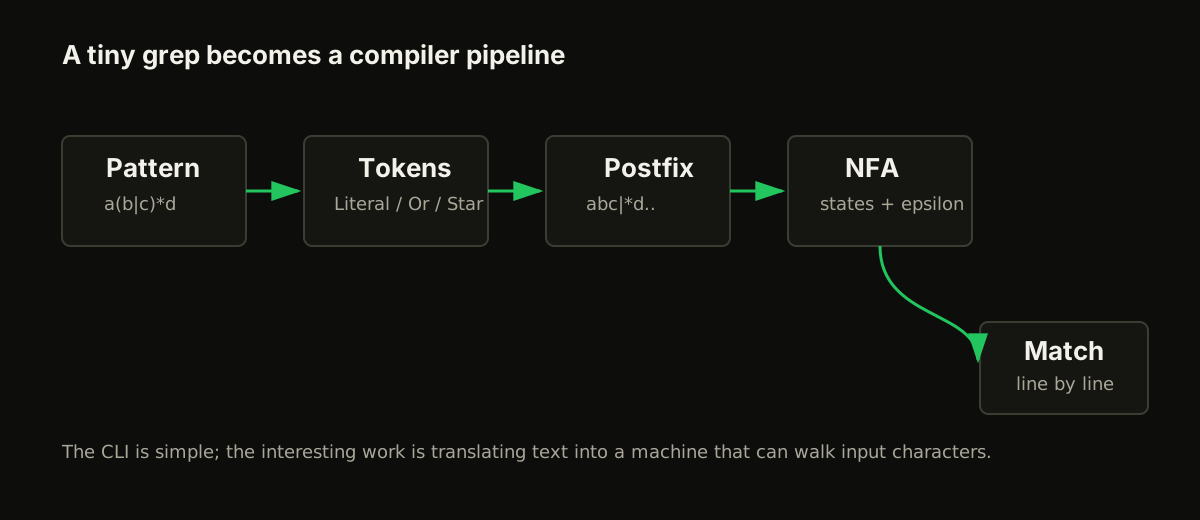
The CLI Is Not The Hard Part
The command shape is straightforward:
myprogram [-r] -E "pattern" [path1] [path2] ...If no path is provided, it reads stdin. If paths are provided, it searches files. With -r, it recursively walks directories and prints matches as path:line.
The core loop is conceptually simple:
for line in reader.lines() {
    if match_pattern(&line?, pattern) {
        println!("{}", line?);
    }
}
But match_pattern is where the project becomes a systems exercise.
Regex As A Compilation Pipeline
The engine follows a classic path:
- tokenize the pattern
- insert explicit concatenation tokens
- convert infix regex syntax into postfix notation
- build a Thompson-style NFA from postfix tokens
- run the NFA against each input line
The parser recognizes tokens like:
- literals
*,+,?|(and)^and$.- character classes like
[abc]and[^abc] - shorthand classes like
\dand\w
One of the useful implementation details is explicit concatenation. Regex syntax hides concatenation:
abreally means:
a concat bThe parser inserts a Concat token where needed. That makes the later Shunting Yard step much cleaner because all operators are explicit.
Why Postfix Helps
Regex syntax is naturally infix:
a(b|c)*dThe engine converts it to postfix:
abc|*d..This is useful because postfix can be evaluated with a stack. When the NFA builder sees a literal, it pushes a tiny machine. When it sees an operator, it pops one or two machines, combines them, and pushes the result back.
That means regex construction becomes mechanical:
- literal -> one transition
- concat -> connect two machines
- union -> branch with epsilon transitions
- star -> loop with epsilon transitions
- plus -> require one match, then loop
- question -> either skip or match once
This is the moment the project starts to feel like a compiler backend. The output is not assembly, but it is still an executable structure: a state machine.
The NFA Model
The engine stores states as IDs with transitions:
pub struct State {
    pub id: usize,
    pub transitions: Vec<(Matcher, usize)>,
}
A transition has a matcher and a next state. The matcher can either consume a character or be Epsilon.
pub enum Matcher {
    Range(Vec<char>, bool),
    Epsilon,
}
Epsilon transitions are the trick that make regex operators composable. They move between states without consuming input.
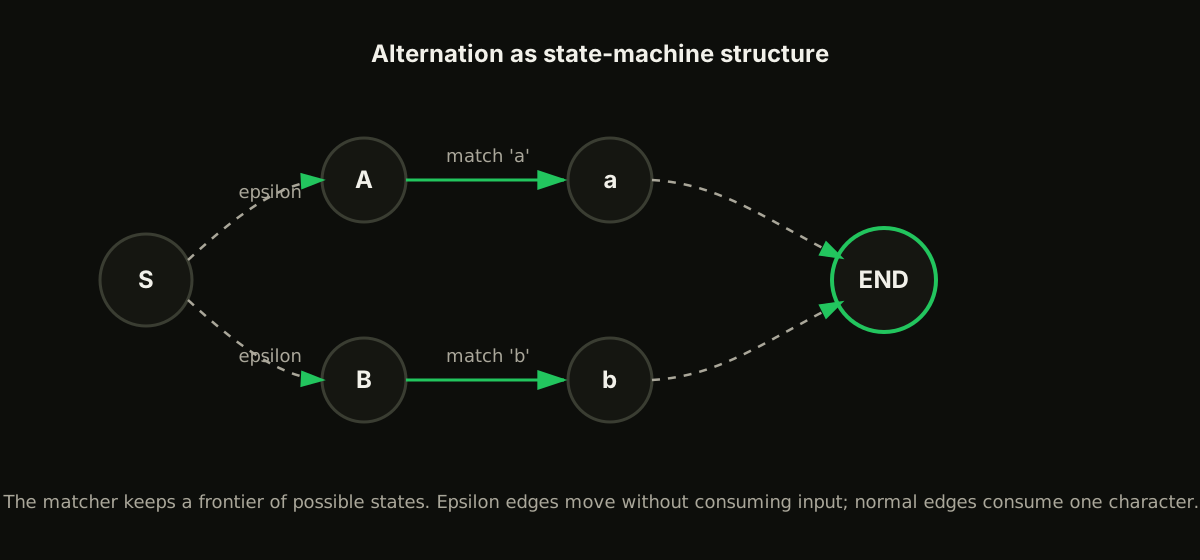
For example, a|b becomes a branch. The start state can move by epsilon into the a path or the b path. Both paths can then rejoin at a shared end state.
The pattern is structural:
- alternation creates branches
- concatenation connects machines
- repetition creates loops
- optional matching creates a skip path
Regex operators are not magic. They are graph transformations.
Matching As State Exploration
The matcher keeps a stack of possible positions:
let mut stack: Vec<(usize, usize, Vec<usize>)> = vec![];
stack.push((self.start_state, 0, Vec::new()));
Each stack item contains:
- current state ID
- current input index
- epsilon-memory for cycle avoidance
At every step, the engine checks transitions out of the current state.
If the transition is epsilon, it moves to the next state without consuming input.
If the transition matches the current character, it advances the input index by one.
If the end state is reached, the engine returns the index where the match ended.
That is the whole mental model:
state + input position -> next possible statesThe implementation is depth-first because it uses a stack. A breadth-first version would use a queue. A DFA version would precompute sets of NFA states into deterministic states.
Anchors Change The Search Strategy
The wrapper around the engine handles ^ and $.
Without ^, the engine tries the pattern at every possible offset in the line:
for i in 0..input.len() {
    let slice = input.chars().skip(i).collect::<String>();
    if self.engine.compute(&slice) >= 0 {
        return true;
    }
}
With ^, it only tries from the start. With $, it checks that the match ends at the end of the input.
This is a nice example of how grep-style matching is different from full-string regex matching. A line matches if the pattern appears anywhere, unless anchors constrain it.
What The Project Supports
The current test suite has 36 passing tests and covers:
- literal matching
- concatenation
- alternation
*,+, and?- start and end anchors
- character classes
- negated character classes
- dot matching
\dand\w- recursive file search behavior through the CLI
The project is intentionally not trying to be production grep. It is a learning implementation. That is a good thing. The value is that every abstraction is visible.
What Could Improve
The most obvious performance issue is that matching unanchored patterns currently creates new String slices while trying offsets. A more serious implementation would avoid allocation and operate on byte or character indices over the original input.
The engine also explores the NFA directly. That is good for clarity, but not always optimal. A future version could:
- convert the NFA to a DFA
- cache epsilon closures
- simplify NFAs after construction
- avoid repeated
input.chars().count() - add lazy quantifier tests
- support backreferences later, with the caveat that backreferences move beyond regular languages
The README also lists a DFA conversion as a possible improvement. That would trade memory for faster matching.
My Takeaway
The best part of this project is that it makes state machines concrete.
Before building it, regex can feel like syntax. After building it, regex feels like a graph:
- parse text into tokens
- reorder operators into postfix
- combine tiny machines into bigger machines
- walk possible states over input
That is a pattern that shows up everywhere in systems work: protocol parsers, lexers, network state machines, workflow engines, stream processors, and schedulers.
grep is a small command-line tool on the surface. Underneath, it is a reminder that a lot of software is just text being turned into states, and states being advanced carefully.