Jun 6, 2026 / 6 min read
Building a Redis Clone in Rust, Then Making It 49x Faster With Profiling
Benchmarking a Redis-compatible Rust server against Redis, profiling the slow paths, and using indexes to remove pathological scans.
I have been building a Redis-compatible server in Rust. It supports core Redis-style commands, RESP parsing, lists, sorted sets, streams, pub/sub, replication scaffolding, and geospatial commands.
Once the server was working, I wanted to answer the uncomfortable question: how far is it from real Redis?
So I added a small benchmark harness that runs the same pipelined RESP workloads against my server and a local redis-server.
Benchmark Setup
Before getting into the numbers, a caveat: this is a local development benchmark, not an official Redis benchmark. The goal was to find bottlenecks in my implementation, not to claim that a toy clone is generally faster than Redis.
The comparison used:
- Redis server:
redis-server v=8.6.2 sha=f6c77b96 malloc=libc bits=64 - Redis CLI:
redis-cli 8.6.2 - Machine: Apple M2
- OS: macOS / Darwin
25.5.0arm64 - Transport: local TCP loopback
- Clone build:
cargo build --release - Workload style: fixed pipelined RESP commands from a small Python harness
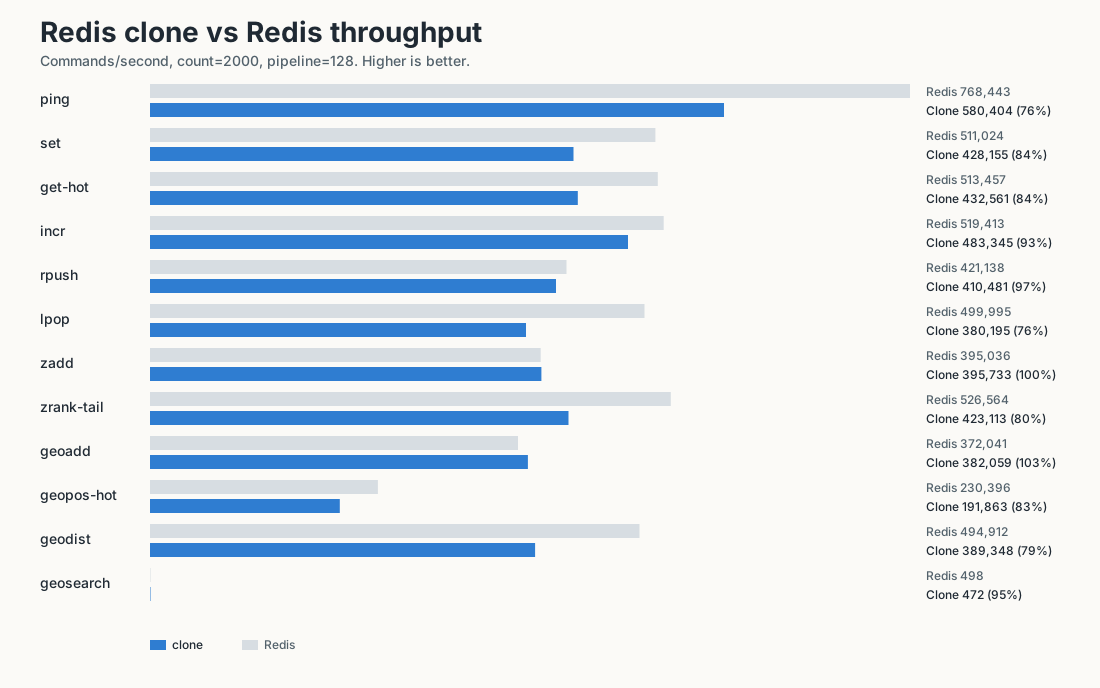
The benchmark script starts my clone on one port, starts real Redis on another port, warms/prepares data for each workload, and then sends RESP commands with a fixed pipeline depth. For the main comparison below, I used --count 2000 --pipeline 128.
The First Results
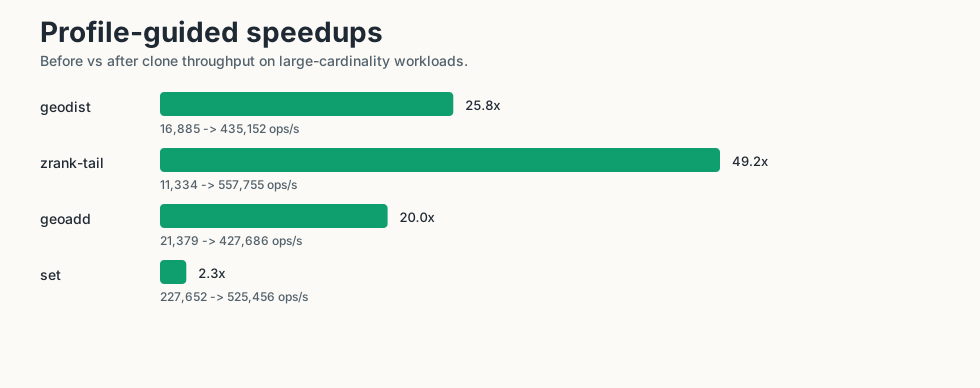
The first comparison was useful, but the real value came from profiling. A few operations were dramatically slower at higher cardinalities:
| workload | before | after | speedup |
|---|---|---|---|
geodist | 16,885 ops/s | 435,152 ops/s | 25.8x |
zrank-tail | 11,334 ops/s | 557,755 ops/s | 49.2x |
geoadd | 21,379 ops/s | 427,686 ops/s | 20.0x |
set | 227,652 ops/s | 525,456 ops/s | 2.3x |
What Profiling Found
The slow paths were not mysterious once I sampled the process.
ZRANK was walking the entire BTreeSet until it found the member:
for (idx, m) in zset.iter().enumerate() {
    if m.member == member {
        return Some(idx);
    }
}
GEODIST did two similar scans, one for each member. GEOADD scanned to check whether a member already existed, then scanned again to remove it when updating.
There was also an embarrassingly good reminder in SET: I still had unconditional println! calls in the hot path. With enough writes, stdout became part of the database benchmark.
The Fix
I kept the ordered BTreeSet for range operations, but added side indexes:
member -> scorefor directZSCORE,GEOPOS,GEODIST, and update checks.member -> rankforZRANK.- Lazy rank rebuilding so writes do not rebuild the whole rank map on every insert.
I also removed the unconditional println! calls from SET.
That changed the shape of the system. The server stopped behaving like “Redis, but every member lookup is a scan” and started behaving like a database with indexes.
Final Snapshot
On a local run with --count 2000 --pipeline 128 against Redis 8.6.2:
| workload | clone ops/s | Redis ops/s | clone/Redis |
|---|---|---|---|
set | 428,155 | 511,024 | 83.78% |
get-hot | 432,561 | 513,457 | 84.24% |
incr | 483,345 | 519,413 | 93.06% |
zadd | 395,733 | 395,036 | 100.18% |
zrank-tail | 423,113 | 526,564 | 80.35% |
geoadd | 382,059 | 372,041 | 102.69% |
geodist | 389,348 | 494,912 | 78.67% |
This is not “faster than Redis.” It is a local benchmark on a limited clone, and Redis is doing a lot more than this project does. Some microbenchmarks look surprisingly close because my clone implements only a narrow slice of Redis behavior.
But it is a satisfying milestone: the obvious pathological cases are gone, and the remaining gaps are more interesting.
What Is Still Slow?
GEOSEARCH still scans every geo member before filtering. The next real optimization is geohash-cell candidate selection, so a radius query only checks plausible nearby members.
The parser also allocates a String per RESP bulk argument. That is convenient, but not cheap. A more serious implementation would parse borrowed byte slices and only allocate where command execution requires ownership.
What Redis Still Does Better
The point of this benchmark is not that my clone is now “Redis-fast.” It is that the most obvious self-inflicted bottlenecks are gone. Real Redis still has a long list of optimizations that this project either only approximates or does not attempt yet.
A few of the big ones I still want to learn from and add:
- Compact internal encodings. Redis can store small lists, hashes, sets, and sorted sets in dense encodings such as listpack-style layouts before promoting them to larger structures. That reduces pointer chasing and memory overhead for small objects. See Redis’
OBJECT ENCODINGand memory optimization docs. - List storage. My list implementation is straightforward, but Redis lists use quicklist/listpack-style storage so many operations touch compact contiguous chunks rather than allocating one independent node per small value.
- Sorted-set internals. This clone now has side indexes, but Redis sorted sets combine direct member lookup with ordered traversal in a mature implementation that handles encoding upgrades, score ordering, range queries, deletion, and memory ownership carefully.
- Geo search candidate selection. My
GEOSEARCHstill scans broadly. Redis stores geo positions as geohash-like scores in sorted sets and narrows the search to plausible neighboring ranges before doing precise distance checks. - RESP parsing and output buffers. My parser is convenient Rust code that allocates owned strings. Redis has a highly tuned C protocol path, client query buffers, output buffers, and years of work around pipelined workloads. The Redis pipelining docs are a useful reminder that network batching is part of the performance story.
- Hash table and keyspace behavior. Redis has production-grade dictionary behavior, incremental resizing, expiration, eviction, persistence interactions, and latency controls. My clone has enough of the shape to learn from, but not the same operational machinery.
- Memory management. My local Redis build reported
malloc=libc, but Redis deployments often pay careful attention to allocator behavior, fragmentation, object layout, and background work. A clone that wants to stay fast at larger memory sizes has to care about this too.
So the next phase is less about one benchmark number and more about replacing simple data structures with the kinds of adaptive representations Redis uses in production.
Takeaway
Building the clone was the fun part. Profiling it was the humbling part.
The biggest improvement did not come from clever Rust tricks. It came from looking at the flame graph, finding a linear scan hiding inside an operation that should feel indexed, and adding the missing data structure.
That is the part of systems work I enjoy most: the code tells you what it wants to become.